
Face Recognition Attendance System for Schools with ERP Integration
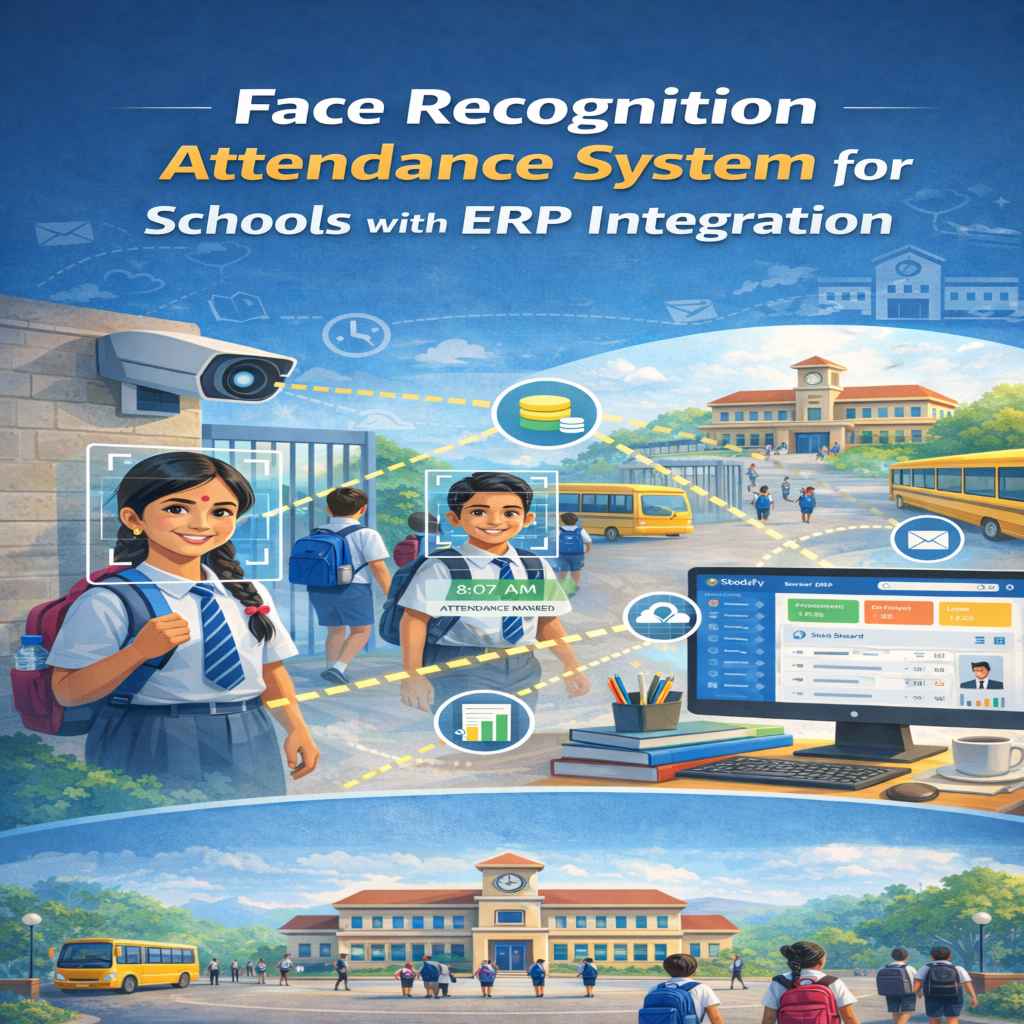
Smart Face Recognition Attendance Solution | Skodefy School ERP
Schools today need faster, safer, and fully automated attendance systems that integrate directly with their School ERP.
Manual registers and even RFID systems still require physical interaction. Face Recognition Attendance eliminates that completely.
With Skodefy Face Recognition Attendance System, students simply walk in and attendance is marked automatically.
No cards. No fingerprint touch. No manual correction.
Everything syncs directly with the School ERP dashboard in real time.
What is Face Recognition Attendance System in Schools?
A Face Recognition Attendance System uses AI-based camera technology to identify students and automatically mark attendance.
Each student’s face is enrolled in the system during admission.
When a student enters the classroom or school gate, the system detects the face, matches it with the stored database, and marks attendance instantly inside the School ERP.
It is completely contactless and removes dependency on cards or fingerprint scanners.
Why Schools Are Moving to Face Recognition Attendance
Schools across India are adopting face recognition attendance because it removes common operational challenges. During morning rush hours, RFID tapping or biometric scanning can create queues. Face recognition works automatically as students walk in.
- No proxy attendance possible
- No card management issues
- No fingerprint mismatch for small children
- Faster entry during peak hours
- Real-time ERP integration
- Improved campus security
Common Problems Schools Face Without Automation
Many schools continue to rely on manual or semi-digital attendance systems. While these methods may work in smaller setups, they start creating operational pressure as student strength increases.
The issues may appear minor on a daily basis, but over an academic year, they become significant administrative challenges.
- Time Loss in Classrooms: Teachers spend valuable teaching minutes calling out names and marking attendance.
- Manual Data Corrections: Attendance mismatches often require office staff to verify and correct records later.
- Proxy Attendance: In higher classes, students sometimes mark attendance for absent friends.
- Delayed Parent Communication: Parents are informed about absence hours later instead of instantly.
- Compliance Pressure: During inspections or audits, compiling accurate attendance reports becomes time-consuming.
- Gate Entry Congestion: Biometric or card-based systems slow down entry during peak hours.
- Lack of Real-Time Visibility: School management cannot instantly view live attendance status across classes.
These operational gaps not only increase workload but also reduce transparency. In today’s education environment, parents expect real-time information and administrators need accurate reporting without manual dependency.
How Skodefy Face Recognition Works
Skodefy Face Recognition Attendance System is designed to be simple for students and effortless for administrators. Once deployed, attendance becomes an automatic process integrated directly into the School ERP.
Step 1: Student Face Enrollment
During admission or system setup, each student’s facial image is captured in high resolution. The system converts this image into an encrypted digital pattern using deep learning algorithms. This pattern is securely stored and linked to the student’s ERP profile.
Step 2: Face Detection & Matching
AI cameras installed at classroom doors or school gates continuously scan for faces. When a student walks past, the system detects facial landmarks and compares them with the enrolled database.
The matching process happens within milliseconds. Students do not need to stop or interact with the system.
Step 3: Real-Time Attendance Update
Once the face is successfully matched, attendance is automatically marked inside Skodefy School ERP. The system records:
- Student Name
- Class & Section
- Date
- Exact Entry Time
Administrators can view attendance live from the dashboard. Optional parent notifications can also be enabled to inform guardians instantly.
Even in cases of temporary internet failure, the system stores attendance locally and syncs automatically once connectivity is restored.
Face Recognition vs RFID vs Biometric Attendance
Before implementing a smart attendance system, school management usually evaluates three options: Face Recognition, RFID Card Attendance, and Biometric Attendance.
Why Schools Prefer Face Recognition
- Completely Contactless: Face recognition attendance works without any physical touch. Students do not need to tap cards or scan fingerprints. This makes the system faster and more hygienic, especially in large schools where thousands of students enter daily. Contactless entry also reduces device wear and long-term maintenance costs.
- No Card Management: Schools do not need to issue, reissue, block, or replace physical ID cards for attendance purposes. There is no risk of students forgetting or losing cards. Administrative staff are saved from daily card-related queries, making the attendance process more streamlined and hassle-free.
- No Proxy Risk: Since the system identifies each student using unique facial features, attendance cannot be marked on behalf of someone else. This eliminates proxy attendance issues, particularly in senior classes where attendance percentage directly affects examinations and compliance reporting.
- Faster Movement: Students can walk naturally through entry points without stopping to interact with devices. This significantly reduces congestion during morning rush hours. Even in schools with 1,000+ students, entry flow remains smooth and disciplined.
- Better Hygiene Standards: Unlike biometric systems that require fingerprint contact, face recognition avoids shared touch surfaces. This supports higher hygiene standards and is especially beneficial in environments where health safety is a priority.
- Fully Automated ERP Sync: Attendance data is automatically updated inside the School ERP dashboard in real time. Administrators can view class-wise reports instantly without waiting for manual entries or corrections, improving operational transparency.
Limitations of Face Recognition
- Requires Proper Lighting: For optimal accuracy, cameras must be installed in well-lit areas. Poor lighting conditions can slightly affect detection speed. However, with correct infrastructure planning, this challenge is easily manageable.
- Initial Enrollment Accuracy: The enrollment process must capture clear, high-quality facial images. Improper enrollment may reduce matching accuracy. Proper setup during the initial phase ensures consistent long-term performance.
- Face Covering Scenarios: In rare situations where a student’s face is fully covered, manual verification may be required. Schools can create simple operational guidelines to handle such cases smoothly.
RFID Attendance Overview
RFID attendance systems use smart ID cards that students tap on readers installed at entry points. The reader captures the card’s unique identification number and sends it to the ERP system. While this system is faster than manual registers and more efficient than biometric scanning in large volumes, it still depends on students carrying cards daily.
- Card Loss Risk: Students may forget, lose, or damage cards, which creates administrative overhead for replacement and blocking.
- Card Exchange Possibility: Cards can sometimes be exchanged among students, which may lead to inaccurate attendance unless monitored carefully.
- Physical Interaction Required: Students must stop and tap their cards, which can slow down movement during peak entry times.
Biometric Attendance Overview
Biometric attendance systems typically use fingerprint scanning to verify identity. These systems are widely used for staff attendance because they provide strong individual authentication. However, in student environments, especially in large schools, operational challenges can arise.
- Slower During Rush Hours: Fingerprint scanning takes a few seconds per student, which can create long queues at entry gates.
- Fingerprint Mismatch in Young Students: Younger children often face difficulty in fingerprint recognition due to softer skin patterns.
- Hygiene Concerns: Multiple students touching the same sensor daily raises hygiene considerations.
- Sensor Maintenance: Biometric machines require regular maintenance and cleaning to maintain accuracy.
Which System is Best for Your School?
The ideal attendance system depends on your school’s size, infrastructure readiness, and long-term growth plans. For small institutions with limited student strength, RFID may be sufficient and budget-friendly.
However, for medium and large schools aiming for structured automation, minimal manual dependency, and better operational control, Face Recognition Attendance provides stronger scalability, better transparency, and smoother entry management.
Why Schools Trust Skodefy
Implementing an attendance system is not just about installing hardware. It directly impacts daily operations, reporting, and parent communication. Schools trust Skodefy because we focus on delivering solutions that work consistently inside real academic environments.
- Designed for Indian School Operations: Skodefy solutions are built considering large class sizes, multiple sections, and peak-hour entry flow commonly seen in Indian schools.
- ERP-First Integration: Attendance does not function as a separate system. It integrates directly with dashboards, reports, analytics, and parent communication modules.
- Scalable for Growth: Whether your institution has 500 students today or plans to expand to multiple branches in the future, the system can scale accordingly.
- Dedicated Implementation Support: From installation to enrollment and staff training, Skodefy provides structured deployment assistance to ensure smooth adoption.
- Multi-Branch Capability: Centralized reporting allows school groups to monitor attendance across multiple campuses from a single dashboard.
- Long-Term Reliability: The system is designed for stable daily operation with minimal downtime, ensuring administrative confidence.
Most importantly, Skodefy builds solutions that administrators can actually manage comfortably — without technical stress.
Implementation Approach at Skodefy
Deploying a Face Recognition Attendance System should not disrupt daily school operations. That is why Skodefy follows a structured and phased implementation approach.
Phase 1: Attendance Automation Deployment
- Infrastructure assessment (entry points, lighting, connectivity)
- Camera installation and configuration
- Student face enrollment process
- ERP integration and dashboard setup
- Admin and teacher training sessions
- Live testing and go-live support
This phase ensures the system runs smoothly before full-scale adoption.
Phase 2: Smart Campus Expansion (Optional)
- Transport GPS integration
- Staff attendance automation
- Visitor management integration
- Access control expansion
- Advanced attendance analytics
Schools can start with attendance and expand gradually without replacing infrastructure. This step-by-step approach keeps investment controlled and manageable.
Technical Whitepaper Summary: Skodefy Face Recognition Architecture
For school management teams who want to understand the technical foundation before implementation, below is a simplified overview of Skodefy’s Face Recognition Attendance architecture.
1. System Architecture Overview
The system consists of three main layers:
- Capture Layer: AI cameras installed at classroom or gate entry points.
- Processing Layer: Deep learning-based face matching engine.
- ERP Integration Layer: Attendance dashboard, analytics, and reporting system.
2. AI Model & Face Matching Accuracy
Skodefy uses a deep learning convolutional neural network (CNN) model to map facial landmarks. Instead of storing plain images, the system converts faces into encrypted mathematical feature vectors.
Under proper lighting conditions, accuracy typically exceeds 95%, ensuring dependable identification.
3. Attendance Data Processing Flow
- Face captured by camera
- Feature extraction using AI engine
- Database matching
- Identity confirmation
- ERP attendance marking
- Optional parent notification trigger
4. ERP Integration Methods
- Direct API integration
- Real-time data sync
- Offline buffer with automatic sync
- Dashboard and analytics integration
5. Data Security & Encryption Standards
- Encrypted facial feature storage
- Secure HTTPS data transmission
- Role-based ERP access control
- Admin-level authentication
- Audit logs for accountability
6. Deployment Model
Skodefy supports cloud-based, on-premise, and hybrid deployment depending on school infrastructure.
7. Scalability & Multi-Branch Support
Centralized dashboard allows multiple branches to operate under one ERP system while maintaining separate attendance records.
8. Future Readiness & AI Expansion
- Smart visitor verification
- Staff face attendance
- Advanced analytics integration
- Smart campus expansion compatibility
Conclusion
Skodefy Face Recognition architecture is designed to be secure, scalable, and practical for real school environments. It supports long-term growth without frequent system replacement.
Frequently Asked Questions (FAQs)
What is face recognition attendance system in schools?
It is an AI-based system that automatically identifies students using camera technology and records attendance directly in the School ERP.
Is face recognition attendance safe for students?
Yes. The system stores encrypted facial data and restricts access through role-based controls, ensuring student information remains secure.
Does face recognition work without internet?
Yes. The system can store attendance locally during connectivity issues and sync automatically once the internet is restored.
Can it integrate with School ERP?
Yes. Skodefy Face Recognition Attendance integrates directly with ERP dashboards, reports, and analytics modules.
Is face recognition better than RFID?
For medium and large schools, face recognition reduces card management issues and eliminates proxy attendance, making it more scalable.
What happens if lighting conditions are poor?
Proper installation planning ensures optimal lighting. Modern AI cameras are optimized for varied lighting conditions.
Is student data stored securely?
Yes. Data is encrypted, access-controlled, and protected using secure transmission protocols.
-

AI-Powered School ERP : The Future of Smart School
20 February 2026 -

Face Recognition Attendance System for Schools with ERP Integration
20 February 2026 -
GPS Tracking System for School Buses with ERP Integration
21 February 2026 -
Smart RFID Attendance System for Schools
16 February 2026 -

Best School Management Software
02 January 2026